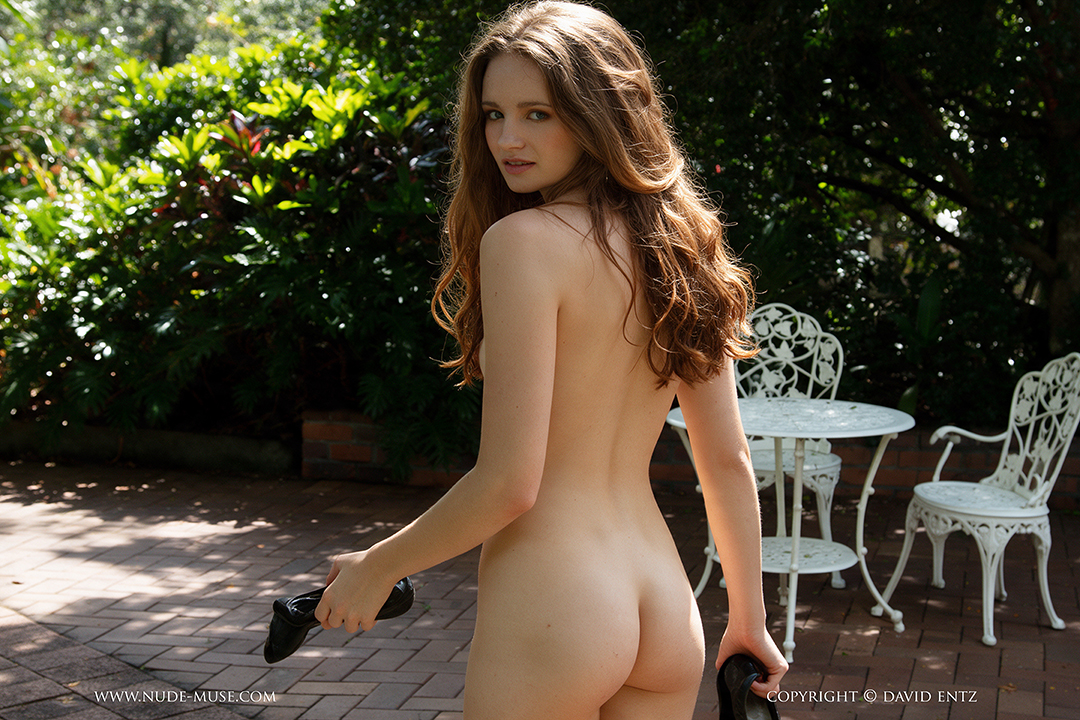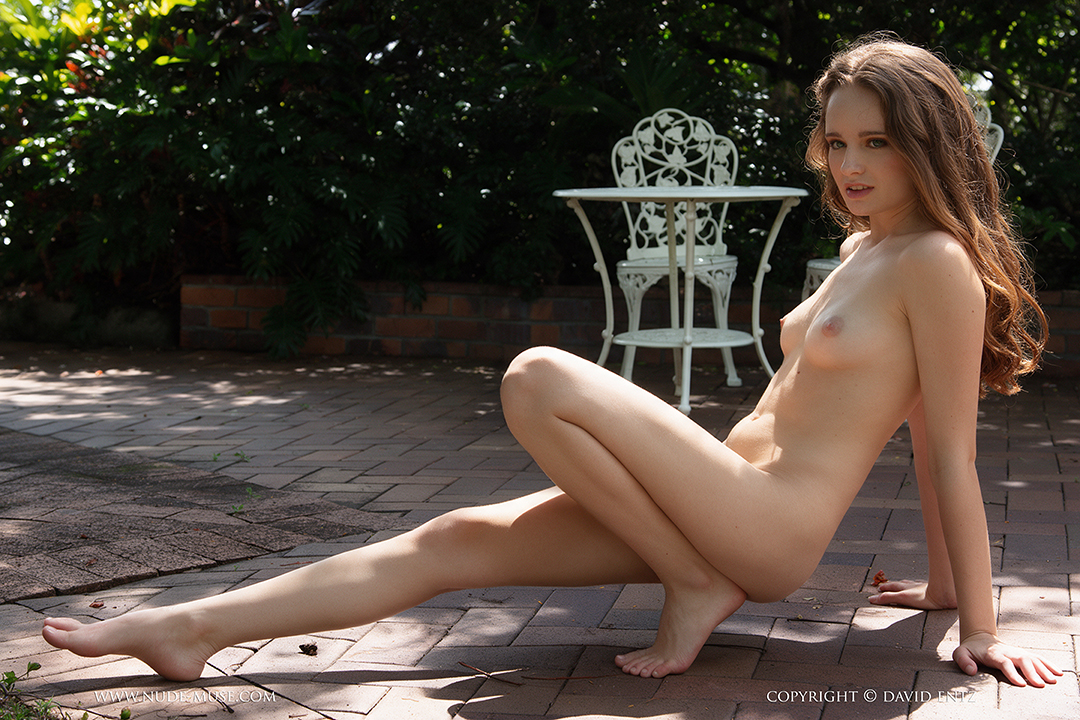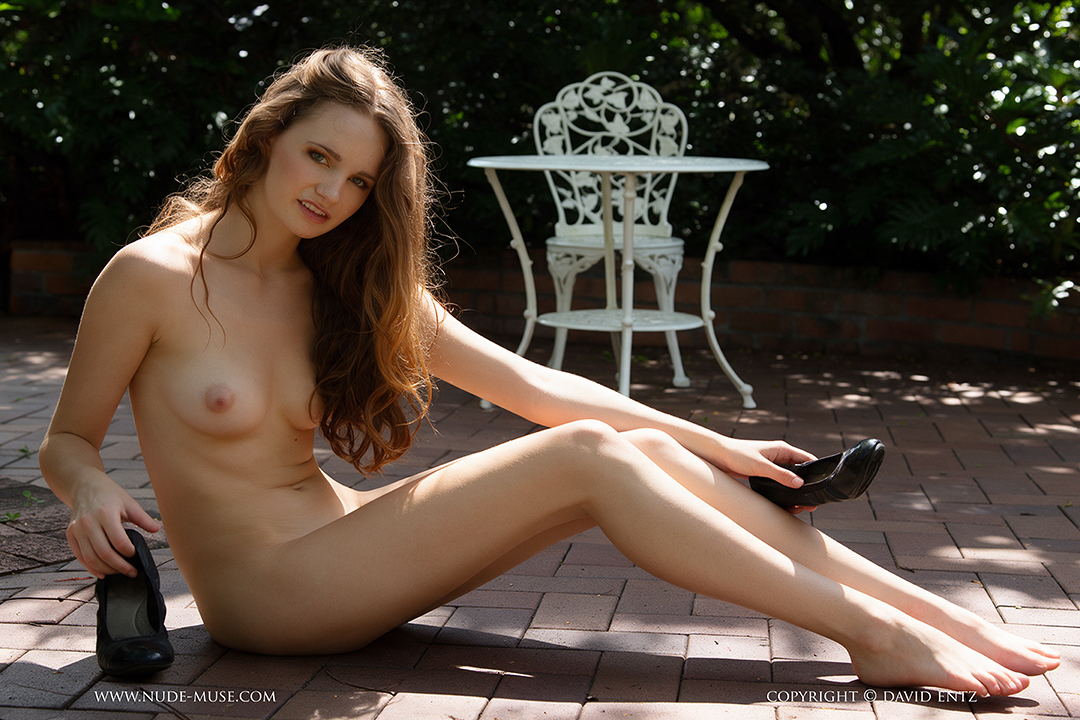
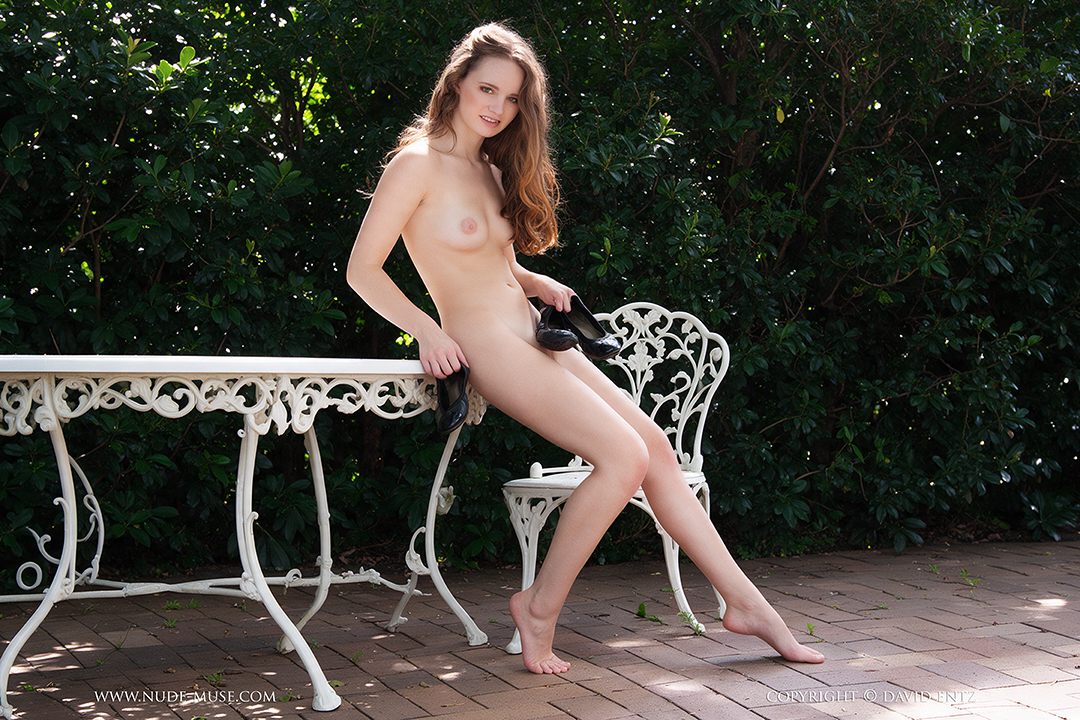



The Courtyard
This set with Evelyn worked out so well, that once again I was suprised. Next week is halloween, so have the Cynthia set ready to go for that one. stay tuned.
I decided to write a short story about Evelyn. This story is totally fiction and as far as I know Evelyn has never done what is in the story. If there are any similarities to real events and real people, it is purely conincidence.
Evelyn had long since learned to treat her body as an instrument rather than a possession, and it was this particular discipline that carried her up the drive to the estate at the top of the hill, where the morning light lay in slanted bars across the brickwork and the hedges stood so thick and dark behind them that they seemed less like plants than like a wall of green shadow. She was 21 years old, five feet six inches tall, with eyes the colour of wet stone, and she made her living by standing still for other people's cameras; it was honest work, in its way, and she did not suffer from the delusion that it was anything more. The estate itself was a place built for the performance of happiness, white iron tables and chairs set out on the patio like props awaiting their actors, the garden trimmed into shapes that no wild thing would ever choose to be, and Evelyn found all of this faintly funny in the way one finds a joke funny when one is already tired.
The man who met her at the gate was middle-aged, with kind eyes and hands that moved as if they were explaining something to a child, and he spoke of light and composition and the particular quality of shade falling through a leaf canopy with such genuine, unselfish absorption that Evelyn felt, for the first time in some weeks, that she had come to see an artist rather than a stranger. He was polite. He was warm. He looked at her as if she were a piece he intended to set down beautifully on his page, and not merely a body he intended to use. She liked him. It would be the last time she did.
He led her to a small white table and chair set against the brick wall, the same ornate ironwork that stood scattered across the courtyard, and there a makeup artist took her in hand and began to work, powdering, blending, lifting the long waves of auburn hair away from her face until Evelyn was, by degrees, made into a cleaner version of herself. She sat through it with the patience of a woman who had been sitting for far worse things, and when it was done she stood, looked at herself in the small hand mirror, and found the result acceptable. Then, because she was professional and because there was no point in performing modesty that would only be undone five minutes later, she undressed on the spot, folding her clothes with the same unhurried care she brought to everything, and asked the photographer what came next.
He pointed, without turning his head, to a large full-length mirror on a stand that had been set up at the edge of the patio, its glass dark and still as a pond in shadow. "You will be posing with that," he said, and then, almost as an afterthought, added that he had acquired it at a deceased estate; it had belonged to a very old woman who was, he said, into esoteric things, which he pronounced the way one pronounces a word one has not quite understood. Evelyn noted this. She noted everything. It was part of the job.
She began to pose. The flash went off, once, twice, a dozen times, each burst of light a small white lightning that stripped the garden flat and left her eyes reeling in the dark between. And it was in those intervals of darkness, in the half-second after the bulb died, that she first saw it: a shape at the edge of the glass, a suggestion of a figure standing where no figure stood, gone before she could look directly at it, gone so fast that to name it would have been to admit she had lost her mind. It is the flash, she told herself, in the calm, level voice she used for all such occasions. The flash is making my eyes see things. I am a professional. I do not imagine.
She leaned against the mirror to hold a pose that required support, and the glass gave way beneath her shoulder, just for an instant, just enough to make her stomach lurch with a cold, weightless sensation, as if she had stepped off the edge of a step that was not there. Then it was solid again, and the feeling was gone, and she straightened up and went on posing, telling herself that old glass in an old frame sometimes warped in the heat, and that she would think no more of it.
"Okay, honey," the photographer said, "now arch your back a little more."
Evelyn's mind registered the word honey with the slow, careful attention one pays to a crack in a dam. She did not say anything. She arched her back. The flash went off.
"Now spread your legs, sweetheart," he said, and leaned forward with an expression of eager, intimate interest, "I want to see a bit more."
Evelyn froze on the brick. The garden stood very still around her; even the dappled light seemed to hold its breath. She looked at him, and she let the professional composure fall away from her like a coat, leaving something colder underneath. "You know I do not do that style," she said, in a voice that was quiet and therefore all the more dangerous, "we agreed. And I am not your sweetheart."
The photographer blinked. He looked genuinely confused, as a man looks when a sentence he has been expecting arrives in a form he did not anticipate. "Since when?" he asked.
"Since forever," said Evelyn. "I only just met you this morning."
"Evelyn," the photographer said, and his voice had gone thin, "we have known each other for almost a year, and you always do saucy posing for me. You always—"
She did not hear the rest of it. She was already reaching for her clothes, pulling them on in the cold air with quick, precise movements, tucking, buttoning, gathering her hair, and when she had done so she turned and walked down the drive without looking back, leaving him standing at the edge of the patio with his mirror and his flashes and his almost-year that was not a year.
She got to her car in the lower lot and put the key in the lock, and it turned, and the doors opened, and she sat in the driver's seat and looked at the dashboard and understood, with the slow dawning of a person who has just stepped off a moving train, that the colour was wrong. It was light blue. Her car was dark blue. She had owned it for three years; she knew its colour the way one knows the colour of one's own eyes, without looking. But the key fit, and the engine turned over, and the car drove, and so she drove, because there was nowhere else to go but home, and a woman does not stand in a parking lot all day reasoning with a fender.
The house at the end of her street answered her key as it always had, and she went up the stairs into the familiar smell of coffee and old wood, and the people who lived there looked at her the way one looks at a stranger who has walked into the wrong room, polite, puzzled, faintly alarmed. We have never seen you before, they said, in turn, each voice a small stone dropped into still water. She went to the bedroom where her boyfriend should have been, he was there, sitting on the bed with his shoes off, and when she spoke his name he looked up at her with an expression of such clean, unfeigned bewilderment that it hurt more than any lie could have hurt, because it was not a lie. I don't know you, he said, and meant it, and had never once in the long history of their lives meant anything like it.
And so she began to look. She looked at everything, and found that almost all of it was as it should be, the books on the shelf in the same order, the mug on the sill with the chip in its rim, the particular crookedness of the hallway light, and yet the small things were wrong, a painting hung a hand's breadth too far to the left, a book she loved missing from the row and replaced by one she had never owned, the colour of the curtains a shade off, the pattern of the rug reversed. The world was her world in every large respect; it was only the joints that did not fit, only the places where one person's life meets another's, and those were all loose, all sliding, as if the whole house had been built by someone who remembered the blueprint slightly differently.
She went back outside, thinking, because Evelyn was a woman who thought in long, careful sentences even when she was frightened, and it was only after an hour of such thinking that the pieces came together with the soft, final click of a lock turning. The differences. The honey and the sweetheart and the almost-year that had not been a year. The cold, weightless lurch she had felt when her shoulder pressed the glass and the glass gave way for an instant and then did not. She looked at her hands. She thought of the old woman who was into esoteric things. And then, with the calm of a woman solving a problem that had no solution but the one she was building, she said aloud to the nearby tree: I may be in the wrong reality.
She went back to the estate before noon. The photographer was waiting for her at the gate, and when she laid out what she had found—the light blue car, the strangers in the house, the boyfriend who did not know her, the small things that would not sit right, his face went through a sequence of expressions that ended in a kind of grave recognition, and he nodded. "I bought it at the same place," he said quietly. "But it was an old man."
Evelyn stopped. An old man. She had been told an old woman. The story is different and that small dissonance sat in her mind like a splinter, confirming what she already suspected: that this place, this threshold, did not keep its accounts straight, and that to pass through it one could not rely on words at all. One had to rely on the body. The body was the only ledger that did not lie.
He brought the mirror out onto the patio and set it in the same spot where the morning light fell across the brick, and Evelyn stood before it and leaned her shoulder against the glass, as she had done before. Nothing happened. The glass was solid, cold, indifferent; it gave no way to a woman who was dressed, who was clothed in the ordinary fabric of this world's expectations. She understood then what the old keeper, woman or man, it did not matter which, had really been trying to say with all that esoteric talk: that the looking glass does not open for the self as it is presented, but only for the self as it is true. And a woman's truth, in a place like this, was not her clothes. So Evelyn undressed. She took off everything, shoes, stockings, dress, the small remaining pieces of the costume she had been wearing all day, and stood on the cool brick in the dappled light with nothing between her and the world but her own skin, and then she leaned against the mirror.
For a brief moment the glass was no longer a surface at all. In it she saw herself, but not quite herself: the same face, the same grey eyes, the same long waves of hair, yet slightly different, as a word is slightly different when it is spelled one letter wrong, and that other Evelyn looked back at her with an expression of such weary, tender recognition that it was like being seen by someone who had been waiting a very long time. The reflection opened its mouth and said, without sound, lean against the mirror, and then it made a pose while still touching the mirror, a seated pose, legs spread wide, hands resting on the ankles, head tilted, a faint knowing smile, and Evelyn, who knew that pose better than she knew her own heartbeat, because it was a pose she was asked to do so many times, but always said no to, Evelyn matched it exactly. She sat down on the brick with her legs apart and her hands on her feet and her grey eyes level, and the moment her body took the shape of the truth, the glass gave way.
She felt that cold, weightless falling again, longer this time, deeper, as if she were sinking through a great depth of still water, and then—
She was sitting on the brick in the dappled light, legs spread, hands on her ankles, and the garden stood very still around her, and in the glass before her the other Evelyn looked back one last time and mouthed two words: thank you. And then the mirror was only a mirror again, dark and still as a pond, and on the other side of it someone else was sitting in that pose, holding the shape of a life that was not hers to live but would be lived well enough, because Evelyn knew what it was to hold a pose until your arms gave out, and she knew that the other woman would hold it too.
Evelyn stood up, dressed herself in the clothes that were now, once again, her clothes, and walked down the drive. Her car in the lower lot was dark blue. The key turned. She drove home, and at the end of her street the people who lived there looked at her and smiled, because they knew her, and in the bedroom her boyfriend looked up from his shoes and said her name with his voice, not a stranger's, and when she went to the bathroom and stood before the plain, unmagical mirror on the wall and touched her own face with her own hand, the woman in the glass touched it back, exactly, without a single letter wrong.
She was home. She was herself, the right Evelyn, the one who belonged here, in this house, in this bed, in these arms that knew the weight of her. And she thought, as she lay there in the dark with his hand across her stomach and the small, steady sound of a world that fit, that it had not been a punishment to be unrecognised for an afternoon; it had been a lesson, the kind of lesson one learns only by being set down on the far side of the glass and made to look back. You are yourself, she thought, in the calm, level voice she used for all such occasions, only when someone holds your pose. And you hold it for them. Outside her window the garden stood dark and still, and somewhere across a distance that had no name another Evelyn sat down on cool brick with her legs spread and her hands on her ankles, and held the shape of a life, and was, in her own way, exactly where she belonged.
Yes Evelyn does have a model profile page, which you can find HERE.
Join now to see more artistic nude photos